


Stadium for Swag
What Does Swag Mean? The Business Guide HR Needs
Swag done right isn't landfill—it's a proven engagement lever. See what business swag means, why it works, and how to build a program that pays off.
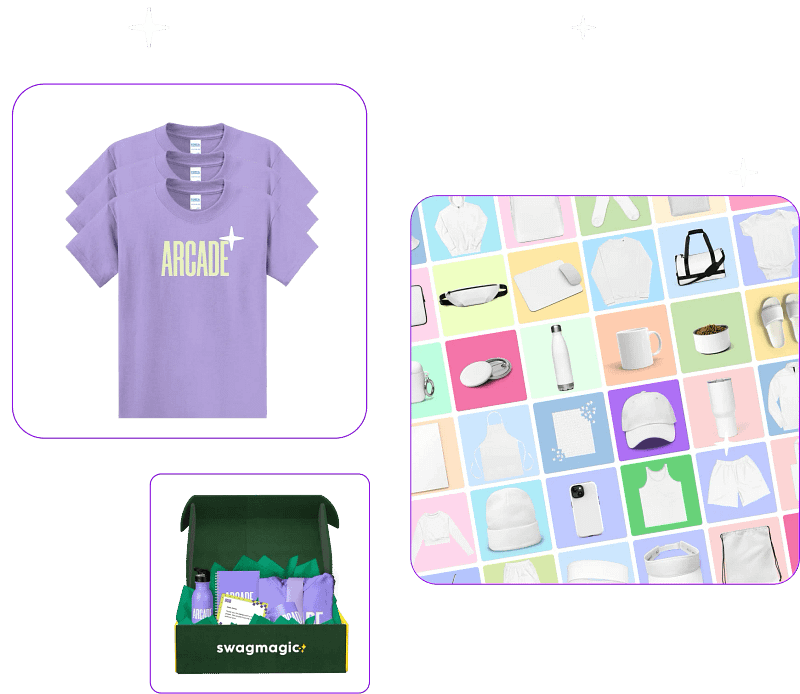








Ask ten people what swag is and most will describe the same thing: the pen that died in a week, the tote bag shoved in a drawer, the conference T-shirt that never fit anyone.
That reputation is real.
It is also about a decade out of date, and it is quietly costing the companies that still treat swag as an afterthought instead of a tool.
Here is the gap.
Done badly, swag is landfill with a logo on it. Done well, it is one of the most tangible ways a company tells an employee, a client, or a prospect that they matter, and that shows up where leaders actually look.
Swag is one of the most concrete ways to deliver that recognition, which is why the word deserves a closer look than a dictionary gives it.
This guide answers what swag means and what it stands for, traces where the word came from, and shows exactly how businesses use it today, from a new-hire kit to a global company swag store.
No monthly fees.
No contracts.
Quick Navigation
What Does Swag Mean?

Swag is free branded merchandise, such as apparel, drinkware, tech, and bags, that companies give to employees, clients, prospects, and event attendees to build goodwill and brand recognition.
In business, swag is a deliberate engagement and marketing tool, not a pile of random giveaways.
That business framing matters more than it looks. The same hoodie can be forgettable clutter or a genuine moment of appreciation depending on one thing: whether the company treated it as a throwaway or as a deliberate touchpoint with a person it wanted to reach.
When a new hire opens a welcome kit on day one, or a client finds a thank-you gift on their desk, the item is doing a job that an email cannot. It is appreciation you can hold.
So while swag technically means “free branded stuff,” the useful definition for a business reader is narrower: branded swag is a physical channel companies use to show people they matter and to keep a brand in view long after a message would have been forgotten. It is one of four ways Stadium helps companies engage the people who power their business. Recognition. Gifting. The rest of this guide is about using that channel well.
Is Swag an Acronym? (Stuff We All Get)
In business, the most common meaning of the SWAG acronym is "Stuff We All Get." It is a playful backronym that caught on in marketing circles, not the word's actual root, but it captures the idea neatly: items everyone at an event or on a team receives. You will also see SWAG used elsewhere to mean a rough estimate ("Scientific Wild-Ass Guess"), but that sense has nothing to do with business swag.
"Swag" Beyond Business (a Quick Disambiguation)
Outside the office, "swag" carries a few other meanings worth clearing up. It is slang for confident personal style, the kind of swagger someone carries into a room. It was once thieves' slang for stolen loot. And, as above, SWAG can mean a rough guess. Each is a real use of the word, but none is what a company means when it orders swag. For the rest of this guide, swag means business swag: the branded items companies give to the people who matter to them.
Where Did the Word "Swag" Come From?

The word has traveled a long way to reach the reception desk at a trade show. “Swag” traces back to “swagger,” which appears in English in the 1500s and carried a sense of swaying or lurching movement, and later, of showy confidence.
By the 1800s, the word had picked up a criminal streak: in thieves’ slang, “swag” meant stolen goods, a bag of loot. Language references such as Merriam-Webster and Wikipedia track this drift from movement to loot to giveaway, which is why they are worth citing when the origin comes up.
The modern business meaning is the newest turn in the story.
By the 1960s, “swag” was being used for the free promotional items handed out at events and conventions, the branded giveaways that companies used to get their name into an attendee’s hands.
That is the sense that stuck in corporate life, and it is the one this guide uses.
What changed most recently is not the definition but the intent behind it.
For decades, swag meant volume: order a thousand of the cheapest logo pen, hand them out, and count it as marketing. The shift over the last several years has been toward quality over quantity, toward items people actually keep and use.
Swag stopped being a trinket a company hoped someone would take and became a deliberate channel that HR, marketing, and events teams plan around.
Instead of a closet full of logo pens nobody wanted, the modern approach is curated, often chosen by the recipient, and delivered wherever that person happens to be.
That evolution is exactly what turns “free branded stuff” into branded swag worth budgeting for, and it sets up the practical question the rest of this guide answers: what counts as business swag, and how do you run it well.
What Counts as Business Swag?

The fastest way to get swag wrong is to start with the product.
The better starting point is the category, because categories map to how businesses buy and to what a given recipient will actually use.
Broadly, business swag falls into five groups: apparel, drinkware, bags, tech, and desk or office items, plus a tier of premium gifts reserved for higher-stakes moments like a top client’s renewal or a milestone anniversary.
Branded merchandise now sits inside just under 70% of North American reward and recognition programs, according to the Incentive Research Foundation, so this is standard practice, not a fringe tactic.
The category that fits depends entirely on the audience and the moment. A new hire, a trade-show attendee, and a decade-long client are three different people with three different expectations, and the same item rarely serves all three.
That is why the strongest programs lean on recipient choice and curated swag kits rather than a single one-size-fits-all product: matching the item to the person is what separates swag that gets used from swag that gets tossed.
A catalog with real range makes that matching possible, which is one reason Stadium’s includes 25,000+ products rather than a short list of logo staples.
If you want a fuller menu of specific picks by occasion, see our company swag ideas guide; the goal here is the logic for choosing, not an exhaustive list.
Apparel
T-shirts, hoodies, caps, and outerwear are the highest-visibility, most-kept category, because good apparel gets worn in public long after the event or onboarding week is over. The catch is fit and quality: a soft, well-cut hoodie becomes someone's default weekend layer, while a stiff, boxy tee goes straight to the donation pile. Apparel is where spending a little more per unit pays off in months of brand impressions.
Drinkware
Bottles, tumblers, and mugs are daily-use items, which gives them one of the longest brand-impression lives of any swag. A quality insulated bottle sits on a desk or goes to the gym every day for years. Here, durability beats novelty every time; a bottle that leaks or a mug that chips is worse than sending nothing, because it attaches the brand to a bad experience.
Bags
Totes, backpacks, and drawstring bags are practical and heavily reused, which makes them strong performers for both events and onboarding. A sturdy backpack a new hire commutes with, or a tote that becomes someone's grocery bag, keeps working for the brand well beyond the moment it was given. Reuse is the whole value, so material and construction are what matter.
Tech
Power banks, wireless chargers, speakers, and cases carry a premium feel that raises the perceived value of the whole gesture, which makes them well suited to clients and to milestone moments where the message is "this one counts." Tech swag signals investment, so it works best when you want the recipient to feel genuinely valued rather than simply included.
Desk and Office
Notebooks, quality pens, and desk drinkware are everyday touchpoints that sit in a person's line of sight through the workday. This is the category where the gap between "kept" and "drawer clutter" is widest, and quality is the deciding factor. A notebook someone reaches for beats ten they ignore, which brings the point back to choice: let the recipient pick the desk item that fits how they actually work, and it earns its place.
Swag vs. Merch: What's the Difference?

Swag is branded merchandise given away free to build goodwill and awareness; merch is branded product people choose, and usually pay for, because they want the brand itself. Swag is a gift the company initiates. Merch is a purchase the fan or customer initiates. That is the whole distinction in a sentence.
The reason the two get confused is that they look identical on a table. A logo hoodie is a logo hoodie. The difference is the direction of the exchange and the expectation attached to it. With swag, the company picks up the cost and hopes the item is good enough to keep. With merch, the recipient has already decided the brand is worth wearing and is willing to spend to prove it. That changes the quality bar: nobody pays for something flimsy, so merch is held to a standard swag has historically been allowed to skip.
| Particulars | Swag | Merch |
|---|---|---|
| Cost to recipient | Free | Usually paid |
| Purpose | Goodwill, recognition, awareness | Brand affinity, self-expression |
| Quality expectation | Historically low, now rising | High from the start |
| Typical audience | Employees, clients, prospects, attendees | Fans, customers, community |
The useful takeaway is that the line between the two is blurring, and on purpose. As companies raise swag quality, they move it toward the merch standard: items so good people would have chosen them anyway.
That is the target worth aiming for with any branded swag program, because swag someone would happily pay for is swag that never ends up in a drawer.
Tools like Stadium’s Customizer exist to make that merch-quality bar realistic at company scale, rather than a one-off splurge.
How to Build a Swag Program That Works
Knowing what swag is and why it works is the easy part. Turning it into a program that runs without a scramble is the payoff, and it takes five concrete steps. You do not need all five live on day one; start with one moment and grow from there.

Map Your Moments
List the audiences and the moments that matter: onboarding, work anniversaries and milestones, events, and client or prospect gifting. These are the recurring points where swag does real work, and naming them turns a vague "we should do swag" into a short, specific list you can actually build around.
Set a Budget and Ordering Model
Decide what you will spend per person per moment, then pick your ordering model to match. Where volumes are large and predictable, bulk keeps the unit cost down; where they are uncertain, on-demand removes the risk of dead stock. Most programs use both, and the budget is what keeps the whole thing honest as it scales.
Choose Items or Offer Choice
Pick items against the four tests, useful, quality, relevant, and responsibly made, or skip the guessing and let recipients choose. Choice is the surest route to relevance, and it is where our company swag ideas guide helps if you want vetted picks by occasion rather than starting from a blank catalog.
Set Up a Store and Automate
Stand up a company swag store so people order what they want and items are fulfilled on demand, then automate the repeatable moments so they run themselves. This is where the program stops being manual work. Stadium Shops handles the branded store and the Automation Dashboard triggers onboarding and milestone swag without anyone assembling a kit by hand, with swag kits ready for the moments that call for a curated set.
Measure and Iterate
Track what actually gets claimed and reused, not just what shipped. Redemption rates and repeat use tell you which items and moments are landing and which to cut. Feed that back into your choices each quarter, and the program gets sharper over time instead of drifting. Because the same platform scales from 1 to 1,000+ recipients, you can start with a single moment, prove it works, and expand to the rest without adding headcount.
Why Businesses Use Swag

The honest reason swag works is not that people like free stuff, though they do.
It is that swag makes appreciation and connection tangible, and tangible appreciation is one of the few levers that moves the outcomes leaders track: engagement, retention, and how well a brand is remembered.
A Slack message saying “great work” evaporates by lunch. A quality item that arrives at someone’s door is still on their desk months later, still doing the job.
Swag is not a culture strategy on its own, but it is one of the most concrete ways a company delivers the everyday appreciation that a strong culture is built from.
That is why swag belongs in the same conversation as recognition and retention, not in the “nice to have” column. Recognition. Gifting. Swag is one of the ways Stadium helps companies make both real. Businesses put swag to work in four main ways.
Employee Recognition and Engagement
- Swag turns recognition from a message into a moment. A kit for closing a huge deal, an insulated bottle for hitting a quarterly goal, a hoodie that marks a five-year anniversary: each one takes an abstract "thank you" and gives it a physical shape the person keeps. The moment is what lands, and the item is what makes the moment last.
- The catch is that quality and choice decide whether it works. Recognition done carelessly can read as an obligation met; recognition done well is unmistakable.
- Inside a recognition program, swag is one of the strongest reward options a sender can reach for, especially when it is tied to real milestones like anniversaries and closed deals rather than handed out at random.
- Recognition kits and swag kits built for these moments let an HR team run appreciation year-round without turning it into a second full-time job. With Stadium, the recognition can also carry Stadium Points, so the win shows up as a reward the person redeems, not just a mention in a channel.
Onboarding and Milestones
- Onboarding is the most reliable, most repeatable swag use in HR, because every new hire is a guaranteed moment worth marking. A welcome kit sets the tone on day one, and it does the most work for remote and global hires, who otherwise start their first morning with a laptop and no sense that anyone was expecting them.
- A branded bottle, a soft hoodie, and a handwritten note turn a cold start into a genuine welcome. The same logic carries through the employee lifecycle: milestone swag marks anniversaries and promotions and keeps recognition going long after the first week.
- The hard part is consistency. An HR team of one cannot hand-assemble kits for hires landing across five time zones every week, which is exactly where the process breaks in most companies.
- The fix is to automate it so onboarding on-demand swag ships itself, produced and fulfilled locally wherever the hire happens to be. Stadium's Automation Dashboard handles the trigger and the logistics, so day one is handled the same way for the hire in Denver and the hire in Manila, with swag fulfilled in 170+ countries rather than boxed up and mailed by hand.
Events, Trade Shows, and Brand Awareness
- At an event, swag has three jobs: pull people to the booth, be worth carrying home, and keep the brand in view long after the badges come off. The biggest recent shift is toward pick-your-own swag at events, where attendees choose their item instead of grabbing whatever is on the table.
- Redemption goes up, waste goes down, and the brand ends up on items people genuinely wanted. For a smaller company, the obstacle has always been that traditional sourcing means high minimums and guessing quantities weeks in advance.
- For an events manager weighing bulk swag commitments against uncertain turnout, that is the difference between eating the cost of a wrong guess and paying only for what people actually claim. It is also a reminder to weigh swag vendors on whether they can flex to event scale without minimums, not just on catalog price.
Client and Prospect Gifting
- Swag is not only an employee tool. A thoughtful item sent to a prospect can open a conversation a cold email cannot; a thank-you gift to a client at renewal time is a low-cost way to reinforce a relationship worth far more; a welcome package to a new partner starts things on the right footing.
- The distinction that matters here is between generic promo and a genuinely good gift. A branded stress ball reads as marketing. A well-chosen item, or better yet one the recipient gets to choose, reads as attention.
- That last point is the practical hurdle: for external gifting you often do not have a mailing address, and asking for one kills the surprise.
- This is where a swag management solution like Swagmagic earns its place, letting the recipient claim and pick their gift through a branded store so the sender only pays for what is actually claimed, no address required up front. One platform covers employees and clients, partners, and prospects, which is the point most recognition-only tools miss: the people who power a business are not all on the payroll.
Atlassian Cse Study
Atlassian ran into exactly that when it needed a pick-your-own swag giveaway for attendees at its on-the-road loyalty-program events, starting in Melbourne, Australia. Rather than commit to a bulk order and hope the numbers were right, Atlassian used Swagmagic for on-demand swag, with a customized Swag Locker whose selections could be revised on the fly and a pay-as-you-go model with no minimum order quantities. The result: 25 attendees were treated to swag they chose themselves, gifting reached recipients in locations around the world, and the event hit a 100% redemption rate, with the program set to expand to future stops in the Netherlands, New Zealand, and India.
How Swag Works Today: From Ordering to Delivery
Most guides define swag and stop. The harder, more useful question is how a company actually runs it in 2026, because that is where budgets get wasted or saved. The old model was a purchasing problem: buy in bulk, store the boxes, hand-ship them, and track it all in a spreadsheet. The modern model is a software problem, and it is far less painful. Three pieces make it work: the company swag store, the choice between on-demand and bulk, and the vendor decision underneath both.

The Company Swag Store Model
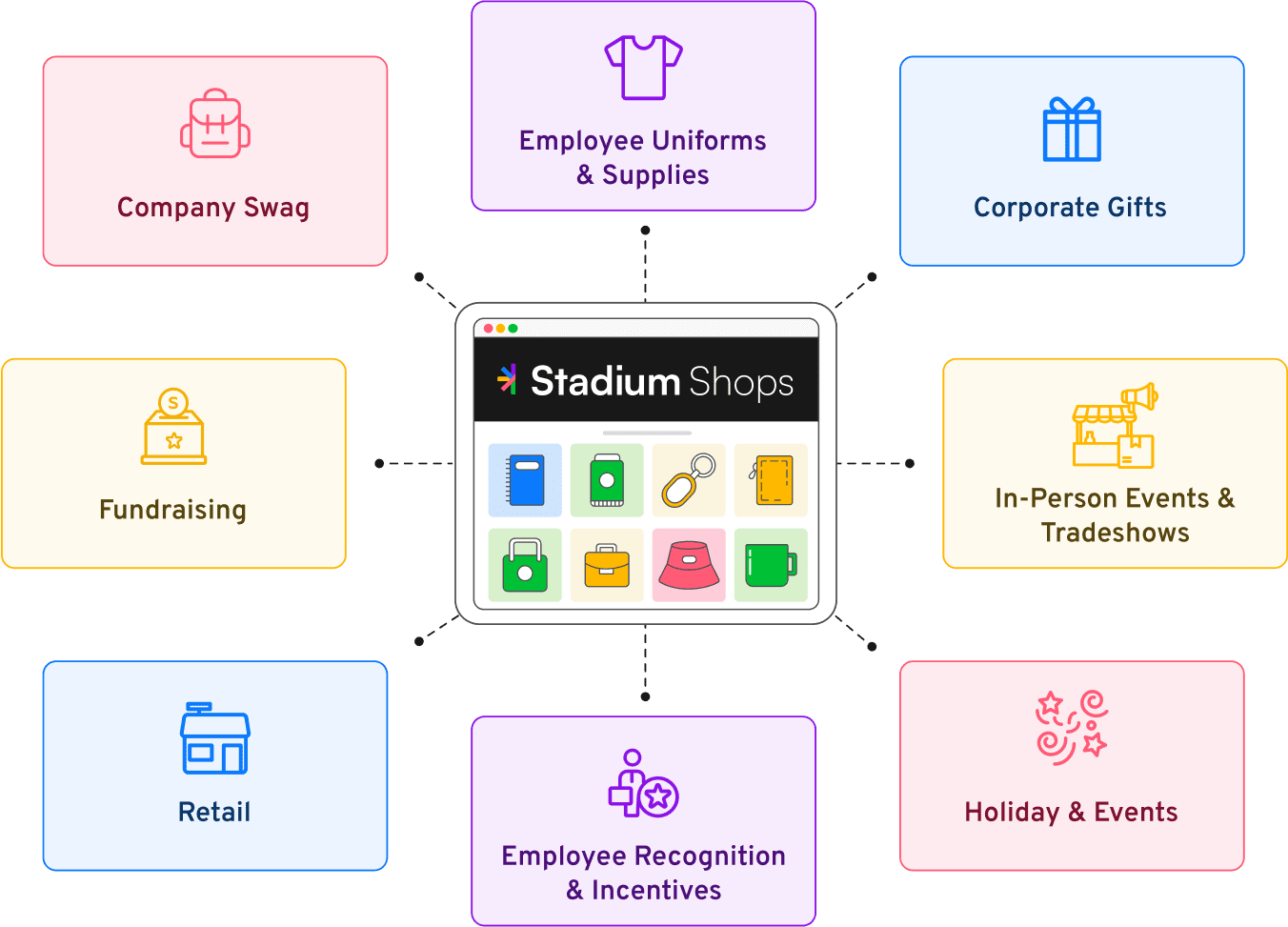
The modern default is a company swag store: instead of a closet of pre-bought stock, a company runs a branded online store where employees, clients, or event guests order the items they want, and those items are produced and fulfilled on demand. You control the currency, the catalog, and the layout so the store looks like your brand, not a generic portal, and a dashboard gives you live inventory and order visibility instead of a running email thread.
Order comes in, item gets produced, item is fulfilled to the recipient, order is tracked, all in one place.
On-Demand vs. Bulk, and Where Kits Fit
The core ordering decision is on-demand versus bulk, and it comes down to how predictable your quantities are.
- Bulk swag means buying a set quantity up front. The unit cost is lower, which is why it still makes sense when volume is known and steady, but the risk is real: over-order and you are paying to store and eventually dump items nobody claimed.
- On-demand swag flips that. Items are produced only when someone orders, so there are no minimums and no dead stock, at a slightly higher cost per unit. The simple rule: run bulk when the volume is predictable and large, run on-demand when it is not, and stop treating it as an either-or, because the right platform does both.
- Swag kits sit on top of either model. A kit is a curated bundle, a welcome set for onboarding, a themed box for an event, a recognition package for a milestone, assembled so the recipient gets a considered set of items instead of one random giveaway. Kits are where the "curated, not cheap" principle from earlier becomes operational: someone has chosen items that work together, and that choice is what makes a kit feel like a gift rather than inventory clearance.
Choosing a Swag Vendor, and Consolidating Them
When you evaluate swag vendors, the checklist is short but decisive: catalog range and quality, real customization, no-minimum flexibility, storage and warehousing, integrations with the tools you already use, and, the one most companies underestimate, global local fulfillment so an international recipient is not hit with customs charges and three-week delays. A vendor that only ships from one country turns every overseas gift into a logistics gamble.
The bigger move is consolidation. In most growing companies, each team quietly signs up its own swag vendor, and the result is inconsistent branding, no spend visibility, and a different login for every group. One platform that fulfills locally in 170+ countries, backed by 500+ global warehouses, 100+ integrations, and the range to scale from 1 to 1,000+ recipients, replaces that sprawl with a single brand standard and a single view of the budget.
Common Swag Mistakes to Avoid

Most swag failures are not creative failures; they are process failures, and they repeat from company to company. Here are the five that waste the most budget, and the fix for each.
- Over-ordering bulk you cannot use. The classic mistake: commit to a thousand units for a headcount you are guessing at, then store the surplus until it is dumped. The fix is to match the ordering model to the certainty. Where volume is unpredictable, on-demand swag removes the guess entirely, because items are produced only as they are claimed.
- Buying cheap items that break. A tumbler that leaks or a pen that dies does not just get tossed, it ties your brand to a bad experience. The fix is to hold every item to the “would they keep this without the logo” test and spend a little more per unit on fewer, better things.
- Ignoring recipient preferences. One item for a whole company guarantees a poor fit for a large slice of it. The fix is choice: let people pick, and the relevance problem solves itself instead of becoming a pile of unclaimed mediums.
- Forgetting global recipients. Ordering for the home office and treating international team members as an afterthought means customs charges, long delays, and a second-class experience for the people furthest away. The fix is local fulfillment, so a recipient in another country gets the same item on the same timeline as one down the hall.
- Treating swag as a one-off. A scramble before every event or onboarding wave is expensive and inconsistent. The fix is to run swag as a program, with repeatable moments set up once and automated, so quality stays even and the work drops.
The pattern underneath all five is the same: swag goes wrong when it is treated as a rushed purchase and goes right when it is treated as a managed, ongoing channel.
The Bottom Line on Swag

Strip away the cheap-junk reputation and swag is simply the most tangible way a company shows employees, clients, and prospects that they matter, delivered as something they can hold rather than a message they will forget. Run it as a one-off and it stays a scramble before every event. Run it as a program, with the right moments set up once and the logistics handled, and it becomes a steady lever on engagement, retention, and how well your brand is remembered.
The timing is on your side. The Incentive Research Foundation found that 52% of North American organizations are predicting an increase in merchandise rewards, and 65% expect event gifting to rise, so swag budgets are growing, not shrinking. The companies that treat swag as real infrastructure now are the ones who will get the most out of that spend.
That is where Stadium comes in: recognition, swag, snack boxes, and gifting delivered as real, high-quality swag, fulfilled locally in 170+ countries, for programs that scale from 1 to 1,000+.
GLOBAL SWAG SOLUTION
Create sleek, Customize-themed online swag stores
Ready to recognize employees in ways that actually land?
From thoughtful employee onboarding gifts to local fulfillment globally, we make it easy to recognize your team, wherever they are.

