









Stadium for Holiday Gifting
40+ Halloween office games and activities for in-office, remote, and hybrid teams. Get ready-to-run ideas, prize picks, and inclusive tips to run this week.
Every October, the office Halloween party lands on one person’s desk.
Usually it’s the HR lead, who now has a week to turn “we should do something fun” into an actual plan.
Then comes the harder part nobody flags: half the team works from home, so a costume contest in the break room leaves them watching a webcam.
Do it as an afterthought and you get forced fun nobody remembers. Skip it and you miss one of the easiest engagement wins on the calendar, a low-stakes reason for people to actually enjoy each other’s company.
This is the fix. Below are 42 Halloween games and activities sorted for in-person, remote, and hybrid teams, plus the prizes and Halloween gifts for employees that make them land, and how to keep the whole thing inclusive.
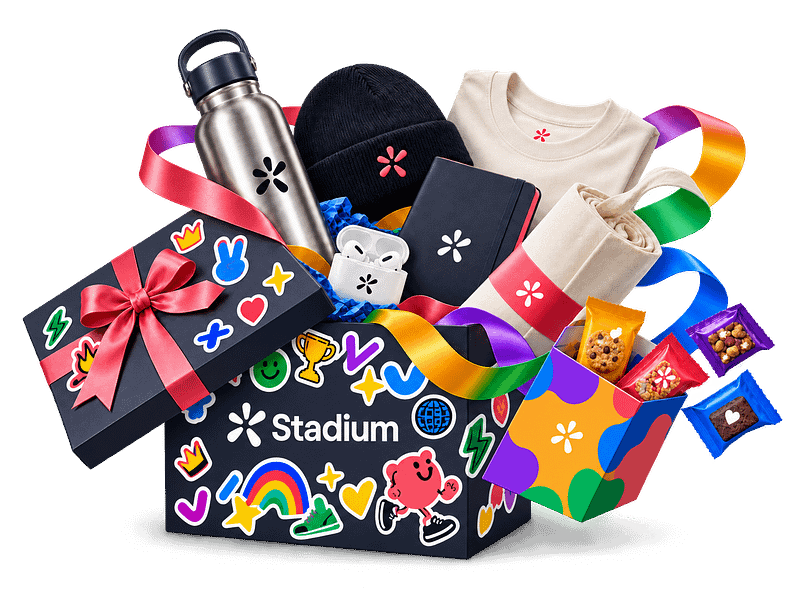
Pick a few, run them this week, and let Stadium handle the swag, snacks, and gifts so the games are the only thing you have to organize.

Celebrate Halloween at work because it’s low-stakes recognition everyone is included in by default.
No one has to earn a seasonal moment, so a shared, costume-optional bit of fun reaches the people formal programs miss.
Run as a repeatable ritual, it builds the connection that drives morale and retention.
That last part matters more than it sounds. Recognition at most companies runs a deficit: only one in three workers in the U.S. strongly agree that they received recognition or praise for doing good work in the past seven days, according to Gallup.
A seasonal moment doesn’t fix that on its own, but it’s a genuine, no-strings way to make people feel seen, and it’s already sitting on the calendar waiting for you.
Here’s the reframe.
Halloween isn’t a one-off party you scramble to plan every October. It’s one beat in a year-round recognition rhythm, alongside work anniversaries, birthdays, and the everyday moments that keep a team connected.
The old way is to reinvent it annually. The better way is to make it repeatable, so it runs on a set cadence instead of your calendar guilt. Stadium’s employee recognition program and Automation Dashboard are built to keep seasonal moments like this on autopilot. Set it up once, and next October the plan is already there instead of on your plate.
The stakes for skipping connection are real, too. Gallup estimates that low engagement costs the global economy US$8.9 trillion, or 9% of global GDP. You won’t close that gap with candy corn. But a recurring, inclusive moment of fun is a cheap counterweight to disengagement, and it’s a lot cheaper than turnover.
Real data, real results. Everything you need to build your holiday program.

Want holiday gifting data?
Explore last year’s trends and insights in our Holiday Report


These are the games that work in a shared space with mixed energy levels and a lunch-hour time box. Most need almost no budget. The few that need supplies are flagged, and the prizes for whoever wins are a solved problem we’ll get to later. The best ones share three traits: they start fast, they don’t need a rulebook, and they pull in the people who would rather not be the center of attention. Pick three or four, not all twelve.
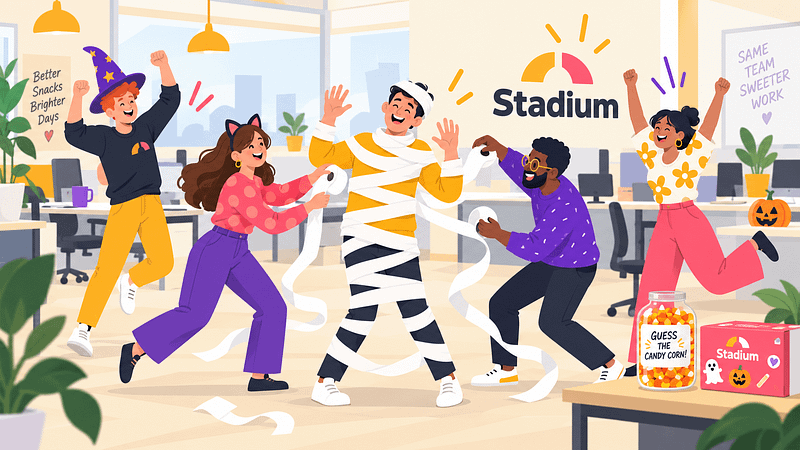
Split into pairs and race to wrap one teammate head to toe in toilet paper. Fastest, most complete mummy wins. It's all-in, needs zero prep, and has no skill barrier, which is exactly why it breaks the ice in about ninety seconds. Keep a few spare rolls on hand for the inevitable rematch.
Set up a few small pumpkins as targets and toss rings or bean bags to score. Run it tournament-style in a hallway or break room with simple point values. Set two or three distance lines so there's an easy throw and a hard one, and it stays fair for everyone. Low supply, easy to score, and it works whether you have five minutes or fifteen between meetings.
Fill a jar with candy corn, set it on a shared desk, and have people guess the count. Closest guess at the end of the day wins. Have people write guesses on a sticky note by the jar, and break ties by whoever guessed first. It runs passively while everyone works, pulls in the folks who would never join a loud game, and costs about the price of one bag of candy.
Give teams or individuals the morning to decorate their desks or cubicles, then open a peer vote in the afternoon. Winners take a category or two. Set a small supply budget or a "use what's on your desk" rule so it stays quick and nobody overthinks it. It runs across the day, needs no scheduled block, and turns visible team spirit into a bit of friendly competition.
Put a string of emoji on the projector and have teams guess the horror movie or Halloween phrase it spells out. Fast rounds, no physical setup, and it scales from a small huddle to the whole floor. Build a dozen slides ahead of time and you're ready to run it on a moment's notice.
Set up a rotating trio of sixty-second challenges: stack donuts on a string, dig plastic bones out of a bag, transfer candy with a straw. People cycle through between other things. Two facilitators and a stopwatch is the whole setup, and a small bracket keeps the energy up as people advance. It's the easiest way to get variety without organizing five separate games.
Have each department set up a small treat station, then let teams walk the trail together. It gets the finance team talking to design, which is the actual point. Stock the stations with a snack box spread from Snackmagic and you skip the last-minute candy run entirely.
Hand out themed bingo cards for a lunch-hour game and call spooky prompts until someone fills a card. It's calm, inclusive, and perfect for people who don't like loud games. A hosted virtual version works for remote teams too, which we cover further down.
Run real categories so it isn't one winner and thirty runners-up: Best Group, Punniest, Best Use of Desk Supplies. More categories mean more people win, which means more people actually participate. Announce the categories a few days ahead so everyone has time to plan.
Skip the carving mess and hand out small pumpkins, paint, and brushes. Individuals or teams decorate, then a peer vote picks winners. Cover the tables, keep a few spare pumpkins for do-overs, and set a twenty-minute timer so it doesn't sprawl. Painting is cleaner and safer than knives in the office, and it gives the people who hate game shows a hands-on way to join in.
Anchor the party with a spread of themed treats and an optional "spookiest dish" mini-contest. Label everything for allergies and keep alcohol off the default menu. A Snackmagic snack box spread covers the coordination and the dietary needs in one order, so no one's stuck chasing a sign-up sheet.
Give everyone five minutes to write a two-sentence horror story, then read them aloud and let the group vote on a favorite. It's seated, quiet, and genuinely funny, and it includes the people who would rather not perform. A hosted storytelling version exists if you would rather not run it yourself.
A party game fills twenty minutes. A team-building activity is built to get people collaborating, not just competing, and that’s a different design.
The best ones hand a team a shared problem, a reason to talk to someone they don’t usually sit near, and a small win to celebrate together.
The payoff is connection, which isn’t a soft metric: just two in 10 employees report having a best friend at work, and the ones who do are far more likely to have fun on the job, innovate, and get more done in less time, according to Gallup.
These team building activities are the vehicle. Connection is the point.
If you would rather not build and run these yourself, Confetti, a Stadium company, hosts several of them live, with a dedicated host and everything set up for you.
Confetti is the live-experiences side of Stadium, so the booking is handled and your team just shows up.

Lock a team into a themed puzzle under a timer and watch roles sort themselves out fast: someone tracks clues, someone runs point, someone spots the pattern everyone else missed. It forces the kind of real collaboration a party game never asks for. For mixed or fully remote teams, Virtual Halloween Escape Quest runs a hosted, haunted-carnival version over video for groups up to 500, split into small competing teams.
Run Halloween trivia, but secretly assign one or two "traitors" whose job is to steer the team toward wrong answers. It turns rote questions and answers into social deduction, and it's a fast read on how your team makes decisions under a little chaos. Virtual Halloween Traitorous Trivia hosts the twist live for groups of 4 to 50 if you want it done for you.
Send teams after a photo-and-clue list, in the building or across their homes, racing the clock to complete Halloween challenges. Cross-team mixing is built into the roster: put people who never work together on the same squad. One sample challenge to get you started: photograph the whole team wearing something orange in under two minutes.
Assign characters, hand out the case, and let the team solve who did it together. The quiet win is that it flattens hierarchy for an hour, an intern and a director trading theories as equals. Printable kits cover most team sizes, and an hour is plenty for one case. It works in a conference room or over video for a distributed team.
Sometimes the best bonding is just a shared campfire moment, minus the campfire. A hosted storytelling session gives a remote or hybrid team spine-chilling tales on a call without anyone on your side having to plan it. Virtual Scary Ghost Stories runs exactly this, live for groups up to 200, with professional storytellers doing the heavy lifting.
Hand teams a light Halloween prompt and a few minutes to build a short, silly skit, then perform. Shared silliness is one of the fastest routes to psychological safety. Keep it opt-in, though: give the people who would rather direct or judge a role, so no one's forced on stage.
Real data, real results. Everything you need to build your holiday program.
Want holiday gifting data?
Explore last year’s trends and insights in our Holiday Report
Here’s the part most office Halloween plans quietly get wrong: they’re built for the people in the building, and the remote half of the team ends up watching the party on a screen. That’s not a small oversight. Gallup found that 20% of the world’s employees experience loneliness, and a celebration that runs without them makes the number worse, not better. A hybrid celebration only counts as one celebration if the remote folks are playing, not spectating.
The fix is two moves. Default to games that run over video so distance doesn’t decide who plays, and put the same physical thing in everyone’s hands. Stadium fulfills swag and snack boxes locally in 170+ countries, so a remote employee in another time zone unboxes the same treats as someone at HQ, on the same day, with no customs drama and no shipping address to collect. Recipient-choice prizes travel through MagicLink™, so winners pick what they want wherever they are. Confetti hosts the games.

A host runs themed rounds over video while teams buzz in and compete. It's the lowest-lift way to give a distributed team a shared forty-five minutes, because no one on your side has to build a single question. Virtual Halloween Trivia hosts it for teams of 2 to 500, and Confetti has run more than 52,000 events, so the format is well past its first rehearsal.
The classics translate cleanly to video: act out or draw a Halloween word while your team races the clock. High energy, low barrier, no supplies to ship. Virtual Halloween Charades runs a hosted version that scales from a single squad to a company-wide crowd.
For an all-hands-sized group, a host calls a themed bingo game and hundreds of people play at once. It's the rare game that works just as well for 12 as for 500. Virtual Halloween Bingo handles the calling and the cards for groups up to 500.
Short on time? Open a regular team meeting with a ten-minute Halloween icebreaker instead of booking a whole event. Themed questions in breakout rooms, then back to work. Try "what's the most on-brand way you'd meet your end in a horror movie?" Virtual Halloween Water Cooler runs hosted Halloween icebreakers for 4 to 200.
Run the costume contest on camera, and add a best-virtual-background category so the people who can't or won't dress up still have a way to win. Screenshot the finalists and let the group vote. Collect entries in a shared thread beforehand so the live vote moves fast. Two categories, more winners, no one left out.
Ship the same Halloween snack box to every employee ahead of a virtual movie or game night, so everyone unboxes and plays with the same treats. It's the prop that makes remote feel shared: same box, same door, same day. Pair it with a hosted game like the trivia above and the night runs itself. Snackmagic snack boxes are fulfilled locally in 170+ countries, which is what makes that "same box everywhere" promise real.
A contest pulls people in because it has stakes and a winner. The trick is to run multiple categories so it isn’t winner-take-all and everyone else tunes out. Frame the prize as something the winner actually wants, not a generic mug, and the whole thing lands as recognition instead of a raffle. (More on prizes next.) Give people a few days’ notice so they can actually prepare, and keep the judging quick so momentum doesn’t stall. Here are the creative, hands-on contests worth running.

Best Group, Punniest, Best Low-Effort, Best On-Camera. The category list is the whole strategy: more ways to win means more people enter, and the low-effort category quietly tells the reluctant folks they're welcome too. Judge by quick peer vote so it stays fast and fair, and give the ballot a five-minute window so results are in before anyone drifts off.
Carve for the full effect in-person, or paint for a cleaner, safer, remote-friendly version. A peer vote decides. For distributed teams, a hosted painting class doubles as the contest: everyone creates on the same call, then votes. Virtual Pumpkin Painting Class runs the class and supplies for groups up to 495.
In the office, people decorate desks and cubicles. Remote, they decorate a video background or a Slack profile. Same contest, everyone included, and it runs passively all day with no scheduled block. Ask entrants to drop a photo in one thread so remote and in-office submissions sit side by side for the vote. Open the vote at 3 p.m. and announce winners before people log off.
Run a "spookiest treat" baking contest, in-office potluck-style with allergy labels on everything. For remote teams, a hosted decorating class is the equivalent: same brief, same judging, no kitchen required. Virtual Halloween Cookie Decorating ships ready-to-decorate kits and runs the class for groups up to 495.
Whole teams coordinate a group costume or theme, which means the collaboration starts days before the party. Judge on cohesion and creativity, not budget. Give each team a shared channel to plan in, and reveal all the group costumes at once so it feels like an event. It's the contest most likely to get a team planning something together on their own time, which is the real win.
Real data, real results. Everything you need to build your holiday program.
Want holiday gifting data?
Explore last year’s trends and insights in our Holiday Report
Not every Halloween moment needs a spot on the calendar. The easiest wins are the ten-minute ones you drop into a meeting you're already having, or run in a channel across the week. These ask almost nothing to set up, work just as well for a hybrid team, and give everyone a reason to smile between tasks. Add one to your next stand-up.

A spooky spin on two truths and a lie: each person shares two real seasonal facts about themselves and one they made up, and the team guesses the fake. It runs in a meeting's first five minutes, needs zero prep, and you learn something new about people you've worked with for years.
Everyone drops a photo or a one-line description of a costume they wore as a kid into a shared thread, and the team matches each one to the right coworker. It's nostalgic, it's a great equalizer, and it works async over a whole week. If you'd rather have it hosted, Confetti runs Virtual Halloween Guess Who live for small teams.
Start a shared playlist and ask everyone to add one Halloween track, from Thriller to a favorite horror-movie score. Play it low during the workday or at the party. It takes each person ten seconds, needs no meeting at all, and the playlist itself becomes a little group project that builds all week.
Fire off rapid either-or dilemmas with a spooky twist: would you rather fight one horse-sized spider or a hundred spider-sized horses? Get trapped in a haunted house or a corn maze? People vote with a hand, a reaction, or a chat emoji. It's fast, funny, and reveals more personality than a whole round of small talk.
Drop a prompt in a channel, like "your Monday face as a horror movie," and let people reply with the best Halloween GIF. Most reactions wins. It's pure low-effort fun, it pulls in the quiet and the fully remote, and it lives right where your distributed team already hangs out.

Stage a competition where small teams race, carving or decorating pumpkins relay‑style.
At each station, one member scoops, the next carves or paints. Timed rounds add stakes, laughter builds, and colleagues strategize.
Award categories like “scariest” or “funniest.” This hands‑on activity encourages teamwork and creativity while fostering fun. Share supplies in advance, set up stations, and announce winners over lunch.
A delightful break that energizes everyone.
Provide sealed boxes filled with spaghetti strands, peeled grapes, or peeled grapes hidden in goo—spooky guesses! A blindfolded participant reaches inside and names what they feel. Spaghetti = witches’ hair, grapes = zombie eyes.
Laughter ensues with every wrong guess. Offer small prizes for correct answers. This sensory surprise game is easy to set up using pantry items and builds light‑hearted interaction across departments in a chillingly fun way.
Transform a corridor or unused office decoration area into a haunted house walkthrough. Use cobwebs, dim lights, spooky props, sound effects, and volunteer “ghosts.” Invite colleagues to stroll through during breaks.
Add surprises like motion‑activated skeletons or burlap ghosts. Encourage each floor or team to decorate a section. Score on creativity and scare factor. Scheduled tours and snack stations at the exit create chatter: a dramatic, immersive way to spook and bond.
Prepare cards or slides with Halloween‑themed emoji puzzles (🧛♂️🍷🦇 = “Vampire Bat Feast”). Teams compete to decode as many as possible in under five minutes. Works well in-person or digitally for hybrid offices. Use printed sheets or a virtual quiz platform.
Keep it light and fast-paced. Offer small Halloween-themed prizes. This quick mental challenge is a clever way to entertain employees and spark competition without a heavy setup.
Design a day‑long office walk among employees. Staff volunteers decorate desks and hand out candy to visitors. Create a map or schedule guiding colleagues through floors or zones.
At each stop, employees receive treats and perhaps quick games or jokes. Encourages movement across departments and spur-of-the-moment chat.
Optional costume dress‑up adds flair. This roaming activity boosts morale, connects staff who rarely interact, and revives childhood nostalgia in the workplace.
A popular suggestion from Reddit involves creating a scavenger hunt with hidden Halloween items and riddles. Teams work together to solve clues and collect objects.
From Reddit r/halloween:
“Spooky scavenger hunt: hide Halloween-themed objects around the office and provide clues for how to find them.”
This idea invites teams to follow riddles or clues placed around desks or common areas. Participants explore, solve puzzles, and gather items. Scoring determines winners. Use candy or mini prizes. The scavenger hunt encourages teamwork, movement, and friendly rivalry in a festive way.
Another highly upvoted Reddit idea is running daily Halloween trivia. This game is low-prep, fun, and adds an educational twist to the celebrations.
Also from r/halloween:
“Daily Halloween‑themed Trivia… make an actual game of it, could create a PowerPoint…”
Set up trivia rounds via slide show displayed in break room or meeting screen. Questions range from spooky history to horror films. Participants answer in teams or individually. Track scores. Offer Halloween-themed prizes or candy. This idea is educational, fun, and low-prep—perfect for integrating knowledge with festive team engagement.
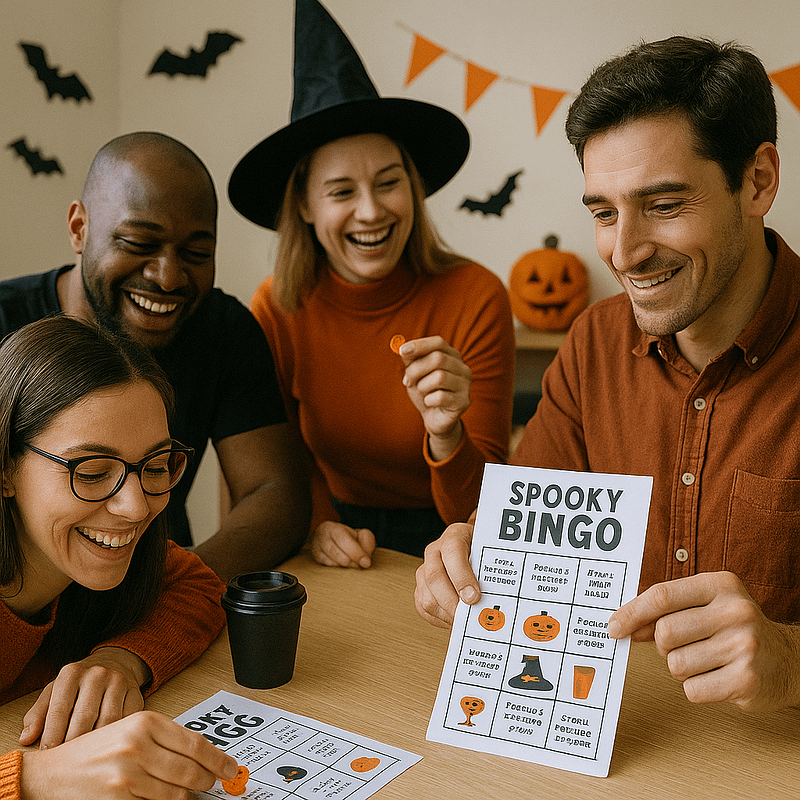
Create customized bingo cards with Halloween‑themed events: “saw someone in costume,” “heard a witch laugh,” “spotted a pumpkin snack.”
Distribute to employees to mark items throughout the day.
Offer small prizes when someone completes a line or a full card. Play remotely via digital bingo tools for hybrid teams.
This flexible setup works all day, encourages colleagues to interact, and keeps excitement high.
Everyone wins with treats or recognition while mingling spontaneously.
You ran the games. Now, what do the winners get, and how does it reach the person who won from their kitchen table in another country? This is the part every competitor's list skips, and it's the part that turns a fun afternoon into a moment people remember.

A $20 gift nobody wanted is worse than no prize at all. The fix is recipient-choice: instead of guessing, you let the winner choose. Stadium brings recognition, swag, snack boxes, and gifting into one platform, with 25,000+ products to pick from, so a winner clicks a MagicLink™, chooses what they actually want, and it's fulfilled locally, no shipping address required. You set the budget, they pick the gift, and the options run from a snack box to a branded swag kit to a gift card, so the same prize pool works for an engineer logging on in Manila and a manager in Denver. The old way is to buy a stack of generic prizes and hope. The better way: let them pick. It lands better every time, and there's nothing left over in a supply closet.
Not everyone wants to act out a charade, and that's fine. Build roles into every game: judge, scorekeeper, photographer, clue-writer, table host. These are real contributions, visible to the group, that don't require performing.
The goal isn't to pull people out of their shell. It's to make sure the shell has a seat at the table. When participation has more than one shape, attendance stops feeling like a test.
The other headache is everything that isn't a prize: the snacks for the in-office spread and the boxes going out to remote employees. Instead of juggling a caterer, an online order, and a swag vendor for one afternoon, you run it from one platform. Snackmagic covers the snack boxes, Swagmagic covers the branded extras, and everything is fulfilled locally from a network of 500+ warehouses in 170+ countries. One order, office and remote, done.
Real data, real results. Everything you need to build your holiday program.
Want holiday gifting data?
Explore last year’s trends and insights in our Holiday Report
The fastest way to sink a Halloween party is to make it mandatory, boozy, and built for whoever happens to sit at HQ. A little planning keeps it fun for everyone, which is the entire reason to run it at all.
Three rules cover most of it. Participation is opt-in, especially costumes and anything that involves performing. Alcohol isn't the centerpiece; offer mocktails or a tasting alternative so the party doesn't exclude anyone who doesn't drink. And remember that not everyone celebrates Halloween, so frame it as an optional fun day rather than an assumption, and give a nod to global teammates who may mark the season differently or not at all.
If you do want an after-hours social for the people who are into it, keep it clearly optional and alcohol-free-friendly. A hosted Virtual Halloween Mixology Class works here, because it runs just as well with mocktails as with cocktails, so no one has to drink to take part. Offer it as an extra, not the main event.
For every person who loves a costume, there's one who dreads being looked at. Build in ways to join that ask almost nothing: voting on the contests, guessing the candy jar, submitting a virtual background, naming the spookiest snack. Recognition is for everyone, and it should never be something people have to perform for to earn. The quiet participants are often the ones who most appreciate being included without being put on the spot.
Here's the real test of an inclusive celebration: does a remote employee in another country get the same experience as someone at headquarters? Making that true is practical, not aspirational. Default to games that run on video, ship the same treats and swag to every location, and use recipient-choice so a prize works anywhere.
Outliant is a good example of the parity done right. The software consultancy's People and Culture team wanted to celebrate work anniversaries by sending branded merchandise to a team spread across 13 countries, without standing up a separate vendor in each one. They ran it through Stadium Shops, designing and distributing swag from one workflow, with no order minimums and consistent pricing across countries. The result: 33 employees received the same quality swag, delivered across 10 countries, on time and within one global budget. That's what distributed celebration looks like when it's real instead of tokenized: same box, same day, every country.

The most memorable office Halloween isn’t the most elaborate one.
It’s the one where nobody, in the building or three time zones away, gets left watching from the sidelines.
Run a few of these games, let people opt in, and give winners something they actually chose, and you’ve turned an afternoon into a repeatable engagement win that took a plan, not a project.
That’s the part Stadium makes easy. Recognition, swag, snack boxes, and gifting run from one platform, fulfilled in 170+ countries, so the games are the only thing you have to organize.
Ready to run recognition, swag, snacks, and gifting from one platform, in 170+ countries?
Celebrate your people year-round with HRIS/ATS integrations that automate employee appreciation gifts for work anniversaries, onboarding, and more.





From thoughtful employee onboarding gifts to local fulfillment globally, we make it easy to recognize your team, wherever they are.


